
Introduction
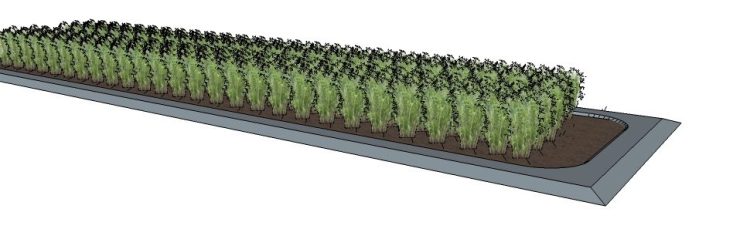
An innovative solution for waste water management which combines a ‘Soil plant-system’ (willow), a Wetland and a Laqua Filter.

Each system has individually been proved to successfully treat wastewater over the recent decades (1,2,3,4) but the combination of all three solves some of the disadvantages of the sole solutions. For example, in comparison with reed beds, the nutrients will be accumulated into the Willow, which can then easily be harvested (nutrient removal), making the system more sustainable in terms of nutrient build-up

The “Hybrid Filter” introduces a barrier which reduces drug residues, Pfas, micro-plastics in the water and the plant nutrients are recycled into biomass for bioenergy resources for combined heat & power. The system energy requirement is gravity and a small pump for recycling when necessary.
A polyethylene shallow constructed wetland pond 4mx20m and 0.4m deep is filled with 0.3m mix of leca and Laqua filter substrate (specific sustainable carbon and peat mix) is constructed and willows are planted into this.
Operation
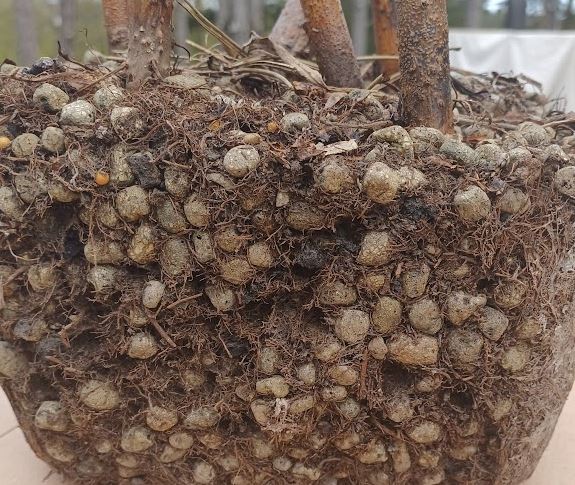
An internal pump recycles the water from the system outlet back to the inlet so the water will continually pass over the willow roots. Roots together with filter substrate create a mesh through which the water flow thue severals times. The water level will differ depending on the setting providing a buffer and protecting the system from drying out to ensure continual root aeration.
By using willow plants, instead of reeds, in a controlled environment, the aim is to reduce the system size. In a full-scale system where the outgoing NH4-N level is monitored, the discharge can be recycled for another “round of treatment”.
Ultimately, the whole system is harvested using a loader with a clamshell bucket to pull out the whole willow (roots, steam, leaves) in 1/3 of filter leaving 2/3 functioning and 1/3 rejuvenating.
References
- Dimitriou, I. & Aronsson, P. 2011. Wastewater and sewage sludge application to willows and poplars grown in lysimeters-Plant response and treatment efficiency. Biomass & Bioenergy, 35, 161-170.
- McCracken, A.R., and Johnston, C.R. 2015. Potential for wastewater management using energy crops. Scientific Papers Series Management, Economic Engineering in Agriculture and Rural Development. Vol 15: 275-284. PRINT ISSN 2284-7995, E-ISSN 2285-3952
- Mirck, J., Isebrands, J. G., Verwijst, T., Ledin, S., 2005, Development of short-rotation willow coppice systems for environmental purposes in Sweden. Biomass and Bioenergy 28, 219 – 228
- Britt-Marie Svensson,Lennart Mathiasson,Lennart Mårtensson, Pille Kängsepp, Evaluation of filter material for treatment of different types of wastwater, Journal of Evironmental Protection,, 2011, 2, 888-894
 Laqua Treatment AB