
Before starting
What to think about before planting, as we can’t be sure how the plant reacts to this particular water or soil as it’s a living plant. One way forward is to gradually start exposing the plant to its new environment. Start small in buckets and then increase in size in pilots, for example in IBC containers or an small plots, testing during all seasons of the year. At the same time, the purification effect can be tested under different loads, which provides us with dimension data for a full-scale plant
Growing environment
That it grows well in the place to be decontaminated. It could be struggle by climatic, toxin in the soil or water that inhibits the plant. Pre-testing in buckets with variants of water blends is the easy way to do a quick test.
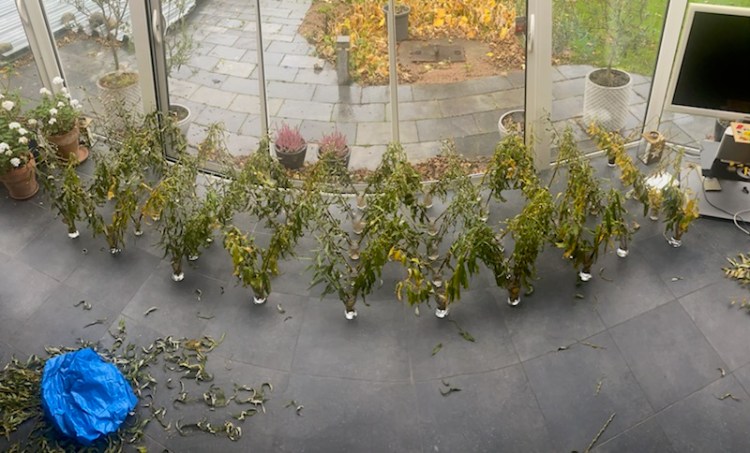
Uptake of PFAS and other hazards
Willow trees are often referred to as “soil pumps” in phytoremediation due to their remarkable ability to draw up and accumulate contaminants from the soil. This process, known as phytoextraction, involves the absorption of pollutants by the tree’s roots and their subsequent concentration in the plant tissues. This mechanism helps to clean the soil, making willows an invaluable tool for remediation projects. Through their natural affinity for absorbing nutrients and contaminants, willow trees serve as effective soil pumps, contributing to the restoration and revitalization of polluted environments.
The plant does not have to be hyper-accumulator but have a high uptake of all pfas lengths. Have a high biomass production as the uptake is largely related to the growth of biomass.
Evaporate lot of water, important as water is the “transporter” and causing Pfas to migrate up into the plant parts. The concentration of Pfas in the water is related to how much and how high in the plant Pfas migrate. Even long Pfas could migrate up into steams and branches. Short Pfas is normally found in the leafs.
Cultivation features
That the plant is available for large areas
Easy to establish, grow and harvest. That there are rational mechanical systems for planting and harvesting. Have a logistic chain al the way to the boiler.
That there is an economic value in the biomass that is created in addition to the value of PFAS uptake.
That the plant has a large proportion of fine roots for optimized uptake/fixation of pfas
Tolerate to being grown under hydroponic / irrigated conditions
Ability to rationally supply nutrients and water for optimized cultivation (thru irrigation)
Adapted to engineered cropping systems for optimized growth/uptake.
Disposal of absorbed pfas.
That there are established logistics and systems to destroy the Pfas and other hazards that have been bound into the plant. Normally by safe controlled incinerating in a boiler
Life-SOuRCE selection of plant for the pilot at Hovgården’s landfill, Uppsala
Hovgården is an old disused landfill where today it is only used for reloading etc.
The groundwater at Hovgården contains about 3000ng/l pfas and then mostly short pfas but also much else as this is largely leakage from the landfill. The chloride content is high, which can inhibit growth, but also nitrogen and heavy metals is high.
Initially, a selection of three plants was made: Hemp, Bunke flo (Carex Elata) and Willow (Wilhelm) suitable for testing.
Hemp fell away, probably due to the chloride content in the water. Bunke flo was growing well, but the growth is modest and there are currently no rational systems for harvesting.
The choice fell on Willow Salix Wilhelm, which in the 2022 season showed good growth and uptake. In 2024, the willow will work for polishing and absorption of the short PFAS, which the Saff has not separated.
 Laqua Treatment AB